
North Carolina's Dental Access Crisis: Why Nonprofit Dental Care Is Essential

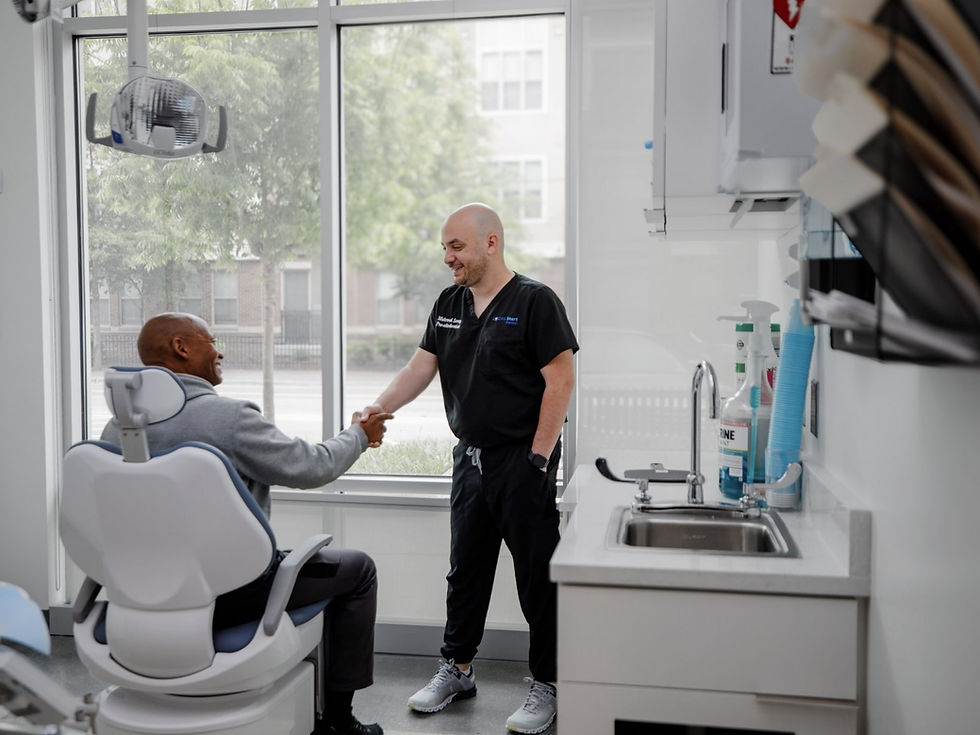
Dental care in North Carolina is not equally available to everyone. Where you live, how much you earn, and whether your employer offers dental benefits largely determine whether you receive care at all. For millions of North Carolinians, the answer to that question has been no, not for years, sometimes not for decades. This is the problem Local Start Dental was built to address. Understanding why it exists requires understanding the scale of what it is working against.
The Geography Problem
Residents in 98 of North Carolina's 100 counties live in a region designated by the federal government as a Dental Health Professional Shortage Area. That is not a minor gap in coverage. That is nearly the entire state.
Data from the Sheps Center for Health Policy Research at UNC Chapel Hill shows that 21 rural North Carolina counties have fewer than two dentists for every 10,000 residents. Four counties, Gates, Camden, Tyrrell, and Hyde, have no dentist at all.
More than half of North Carolina counties have fewer than four dentists per 10,000 people. For patients in those counties, the nearest comprehensive dental clinic may be hours away. For patients without reliable transportation, that distance is not an inconvenience. It is a barrier that determines whether they receive care at all.
This is not a new problem. In the last 40 years, the number of practicing dentists in the state doubled, but the increase did not keep pace with the state's population growth. The supply of providers is not growing fast enough to meet the need, particularly in rural communities where dentists are difficult to recruit and retain.
The Cost and Insurance Problem
Geography is one barrier. Cost is another. Dental insurance, where it exists at all, typically comes through employers. For workers in low-wage industries, part-time workers, self-employed individuals, and retirees, dental coverage is often simply absent. And without insurance, even a routine cleaning can cost hundreds of dollars out of pocket, placing preventive care out of reach for households already managing tight budgets.
The consequences of that math are well-documented. An American Dental Association survey of North Carolinians found that 18 percent of adults said the appearance of their mouth and teeth affected their ability to interview for a job. More than 20 percent said they avoided smiling because of the condition of their mouth and teeth.
These are not abstract statistics. They represent people who are making professional and social decisions around a health problem they cannot afford to address. Untreated dental disease does not stay in the mouth. It affects nutrition, speech, sleep, self-presentation, and confidence. It contributes to systemic health conditions. And it compounds over time: deferred care leads to more expensive care, which leads to further deferral.
The biggest barriers are lack of dental insurance, affordability, and the ability to get timely appointments. Someone may have to wait six to nine months for a dental appointment when they may be having tooth pain, and when they get that appointment, it may be just for a planning process rather than something that treats the pain.
Why the Traditional System Cannot Close the Gap Alone
The private dental market is not designed to serve patients who cannot pay market rates. That is not a criticism; it is simply the reality of how private practice works. Dentists operating in private practice have overhead, staff, and equipment costs that require consistent revenue to sustain. Treating patients at a loss is not a sustainable model.
The public system, primarily Medicaid, offers some coverage, but participation among providers is limited. Only about 40 to 45 percent of active licensed dentists in North Carolina participate in the Medicaid dental program, and many do not accept new patients. Low reimbursement rates are the primary driver: in 2022, dental procedures comprised 14 percent of services to Medicaid beneficiaries, but payments to dental providers accounted for only around 2 percent of Medicaid spending. When the economics do not work for providers, participation declines, and patients who rely on public coverage are left without accessible care.
North Carolina's oral health safety net is strong, but it is not large enough to meet all of the state's needs. The patients who fall outside the safety net, who earn too much to qualify for public assistance but too little to afford private care, represent a significant portion of the population with unmet dental need.
For a full breakdown of what dental coverage exists for adults in North Carolina, see our guide to Medicaid dental coverage in North Carolina.
What Nonprofit Dental Care Does That the Market Cannot
Nonprofit dental clinics operate with a different mission than private practices. They are not optimized for revenue. They are optimized for access. That fundamental difference in orientation allows them to serve patients that the private market and the public system both miss.
At Local Start Dental, the sliding scale fee structure means that what a patient pays reflects what they can actually afford. A patient with very low income may pay significantly less than the cost of their care. A patient with moderate income may pay closer to the actual cost. The difference is covered by a combination of donor contributions and revenue from the Southeast Institute for Dental Education, our continuing education program that trains practicing dentists in complex restorative procedures.
For patients putting off care because of cost, our guide to pro bono dental care at Local Start Dental explains what is available and how to access it.
This model allows Local Start Dental to serve patients who qualify for neither fully subsidized public care nor private market care at full cost: the uninsured, patients on fixed incomes, people in between employment, people whose employers do not offer dental benefits. In short, a large portion of the North Carolina population that the dental care system was not designed to serve.
Since opening in 2021, Local Start Dental has delivered $19.4 million in donated dentistry to more than 3,500 patients from 78 of North Carolina's 100 counties. Patients travel from across the state to receive care in our downtown Durham clinic because, for many of them, there is no closer option.
The Problem Is Too Large for Any Single Organization
Local Start Dental does not operate under the illusion that it can solve North Carolina's dental access crisis alone. The scale of need is too large, the geography too vast, and the systemic barriers too entrenched for one clinic, or even a network of clinics, to address entirely.
What nonprofit dental care does is demonstrate that a different model is possible: that complex, high-quality restorative dentistry can be delivered to people who cannot afford it, that the model can be financially sustainable, and that the impact extends far beyond the procedures themselves.
Every patient who receives care at Local Start Dental is one fewer person navigating the consequences of untreated dental disease. Every donor who supports the work makes it possible to say yes to one more patient from one more county who had no other option.
North Carolina's dental access crisis will not be solved quickly. But it can be addressed, one patient at a time, by organizations that exist specifically to close the gap the traditional system leaves open.
Support Local Start Dental's work. Refer a patient. Volunteer your time. Every contribution, at every level, matters.


